
Dog Training Fundamentals
Resources and More
Downloadable Resources
 Good Human – Enrichment Now! eBook
 Good Human – Foundation Skills Workbook
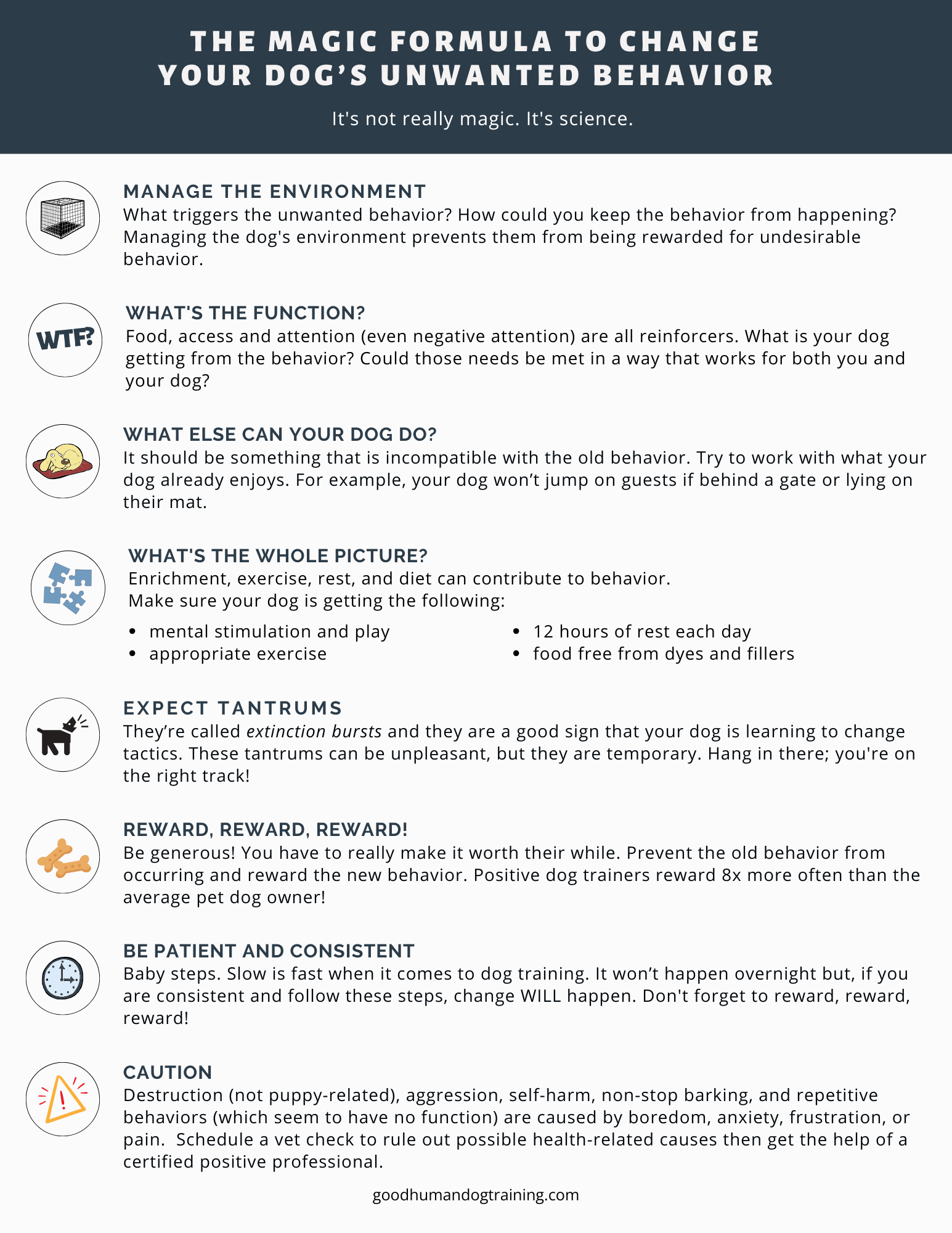 Good Human – Change Your Dog’s Behavior
First Assignment
Dogs learn continuously throughout their waking hours, not just during dedicated training sessions. While having a couple of 5-minute focused training periods each day is valuable, you’re constantly guiding them toward making good choices. Incorporate training into playtime and games to make the experience more engaging and enjoyable for you and your dog.
Marker Word (Foundation Skills workbook – page 10)
Your marker (clicker or succinct word such as “yes”) is your communication system with your dog. It is a word or sound that means “I like that! You’re right!” Whenever your dog does what you want, say “Yes” and follow immediately with food or praise. Ensure you incorporate it into your training and never say it without following with a food treat.
Reward Markers: How and Why to Use them in your Dog's Training – 4Paws University – Lisa Mullinax
Voluntary Attention (Foundation Skills workbook – page 11)
Remember to capture as much attention as you can. You will always get more of whatever you reward, and attention is one of your foundation behaviors based on which all other training is based. When your dog looks at your face or when you call their name, say “YES” and follow immediately with food or praise.
Eye Contact – Kikopup – Emily Larlham
Fading the Lure (Foundation Skills workbook – page 12)
Gradually reducing a lure prevents dependency on treats or lures. You don’t want your dog to behave only when they see food.
Typical process:
- Use the lure to guide your dog into position
- Gradually make the lure movements smaller
- Eventually use an empty hand signal
- Finally rely only on verbal cues when needed
Demo of Fading a Lure and Adding a Verbal Cue – Kikopup – Emily Larlham
Naming the Behavior (Foundation Skills workbook – page 13)
Cues are anything that prompts your dog to perform a behavior. They can be verbal, gesture, environmental, etc. If your dog can experience it, it can be a cue.
Key principles:
- Timing matters – give the cue before the behavior, not during or after
- Keep it simple – short, clear cues work better than complex ones
- Add the cue only after your dog reliably performs the behavior with a lure
Cue vs. Commands in Dog Training – Lisa Desatnik
Cue Planning Worksheet (Foundation Skills workbook – page 14)
Plan the cues for the behaviors you are training your dog.
Hand Targeting (Touch) (Foundation Skills workbook – page 15)
Teaching your dog to target your hand is a valuable training tool. It can help your dog walk next to you, teach a trick, or provide a distraction during stressful moments.
How (and Why) to Teach Hand Targeting – Smart Dog University
Sit (Foundation Skills workbook – page 16)
Lure a sit and immediately say “Yes” and follow with food or praise. Quickly release your dog from the sit by saying “Free” or “Okay.”
Teach Your Dog to Sit – AKC – Nancy Field
Stay – Level 1 (Foundation Skills workbook – page 19)
Ask for a sit, and feed your dog 3–5 treats in a row as they sit. Then say “OK” and encourage your dog to get up. If your dog stands up every time you give a treat, instead ask for a sit, count to three, then release with “OK.”
Teach Your Dog to Stay in 3 Easy Steps Force Free – Zak George's Dog Training Revolution
Building Duration to Stay – Kikopup – Emily Larlham
Place (Foundation Skills workbook – page 24)
Creating the contrast between many treats when down and none when standing will make down on the mat a desirable position.
Teaching Your Dog Place/Stay – Atta Pup – Laura Nalven
Leash Manners (Foundation Skills workbook – page 29)
A great way to practice loose-leash walking is inside the house without a leash: lure your dog to your side at your knee, treat, then turn and walk away. Repeat.
Leash Manners video playlist
Name Game (Foundation Skills workbook – page 17)
In a quiet area, say your dog’s name. When they look at you, mark “Yes” and treat.
Crate Training
To acclimate your dog to their crate, put a long-lasting treat or frozen Kong inside. Sit by your dog, then open the door just as they finish the treat so they don’t barrel out.
Crate Training video playlist
Second Assignment
Voluntary Attention (Foundation Skills workbook – page 11)
Reward any unasked-for attention generously, especially outside. Volunteered attention is more valuable than requested attention.
Attention in New Locations
Brito Acclimating to a Brand New Place – Denise Fenzi
Watch how the handler lets her dog explore before work, noting the “shake off” and air-sniff signals.
Consent for Petting and Handling
Respect your dog’s choice to opt in: invite approach, pause mid-petting, and watch for relaxed body language. Never force handling.
Consent Test Movie – DogKind – Kelly Lee
Attention to Handler, Outdoors
At a park, as distractions approach, “stuff the puppy” with rapid treats until the distraction passes.
Attention to Handler video playlist
Place, with a Default Down (Foundation Skills workbook – page 24)
Touch the mat, wait for the down, then reward. Release with “OK” when both back feet are on one side.
Stay – Level 2 (Foundation Skills workbook – page 23)
Your dog remains in position while you begin to move away, building self-control.
Leash Manners
Reward where you want your dog’s head; become a post if they pull so they cannot reach the distraction.
Leash Manners video playlist
Left and Right Turns (Foundation Skills workbook – page 30)
Lure left and right turns to teach your dog to follow your body.
Heelwork Left Turns – Kikopup – Emily Larlham
Recall (Come When Called) (Foundation Skills workbook – page 21)
Build big recalls from small, successful repetitions.
Off-leash Reliability from a Positive Gun Dog’s Perspective – Thomas Aaron
Come When Called video playlist
Recall Games (Foundation Skills workbook – page 22)
Make recall fun with games—dogs and humans learn best when we’re having fun!
Meet and Greet at Home
- Send your dog to their crate for a Kong three times daily.
- When visitors arrive, keep your dog crated until excitement subsides.
- Leash your dog, treat at a distance, then ask for a sit before greeting.
- Repeat 4–5 times until your dog settles.
Meet and Greet in the Neighborhood
Politely ask neighbors to respect your dog’s training: “My dog is in training—please wait to be invited.”
Be Your Dog’s Advocate – Cold Nose College – Lisa Waggoner
10 Thoughts About On-Leash Greetings – Good Human Dog Training – Jennifer Thornburg
Dogs Love Me: Protecting Your Dog From Well-Meaning Dog Lovers – 4Paws University – Lisa Mullinax
Play a lot and practice briefly every day—consistency is key.
Third Assignment
Voluntary Attention (Foundation Skills workbook – page 11)
Reminder: reward any unasked-for attention generously, especially outside.
Look At That
Teach your dog they may look at environmental triggers but must check back with you.
LAT (“Look at That”): A Training Exercise for Reactive Behavior – East Bay SPCA
Engage Disengage / Look at That – Dog Training – Andre Yeu
Interest in Wildlife
Teaching My Hound NOT To Hunt – Barks from the Guild/PPG – Karen Baragona
Place with a Default Down (Foundation Skills workbook – page 24)
Touch the mat, wait for the down, then reward. Begin adding hand signals and “stay” cues when settled.
Leash Manners
Show the treat, then move it to your chest—reward only calm walking.
Leash Manners video playlist
Stay – Level 3 (Foundation Skills workbook – page 26)
Work on one criterion at a time: Distance, Duration, or Distraction.
Leave It (Foundation Skills workbook – page 27)
Practice “Leave It” in varied locations—walls, different rooms, etc., rewarding generously.
Recall
Everything you do builds recall—if other dogs are more fun, recalls around dogs will never be solid.
Come When Called video playlist
Meet and Greet
When your dog is calm, let visitors offer treats. Ask visitors not to approach until invited to ensure positive experiences.
Enrichment
Choose three activities from Enrichment Now! (page 49). Note ease of use, effect on your dog, and enjoyment. Use the Enrichment Planner to personalize your plan.
Fourth Assignment
Attention
If your dog cannot give you good attention at this stage, the environment is too stressful. Choose a calmer setting.
Look At That
Continue LAT using the resources from the Third Assignment.
Place (Foundation Skills workbook – page 24)
No treats in hand: place treats between front paws to encourage the down.
Advanced Stay (Foundation Skills workbook – page 28)
The Advanced Stay, Part 1 – Smart Dog University – Laurie Luck
The Advanced Stay, Part 2 – Smart Dog University
Recall
Build the bond: timid dogs may need on-leash practice until confident off-leash.
Calming Chin Rest
When your dog rests their chin in your hand, mark “Yes,” pause briefly, then treat.
Easy Chin Rest – Kikopup – Emily Larlham
Teach Your Dog a Collaborative Chin Rest – Terrie Hayward
Leave It on the Road
Practice “Leave It” in varied locations—walls, different rooms, etc., rewarding generously.
Leash Manners
Explore new environments once indoor skills are solid.
Leash Manners video playlist
Fading Food Reinforcers (Foundation Skills workbook – page 31)
Use non-food rewards when possible (e.g., door opening). If behaviors break down, increase reinforcement frequency.
Question, Comments, Snide Remarks?
Need More Than an Guide?
These resources are a great start—but if you’re feeling stuck, overwhelmed, or just want a little backup, we’re here for that too. Let’s build a plan that’s tailored to your dog, your goals, and your daily chaos.